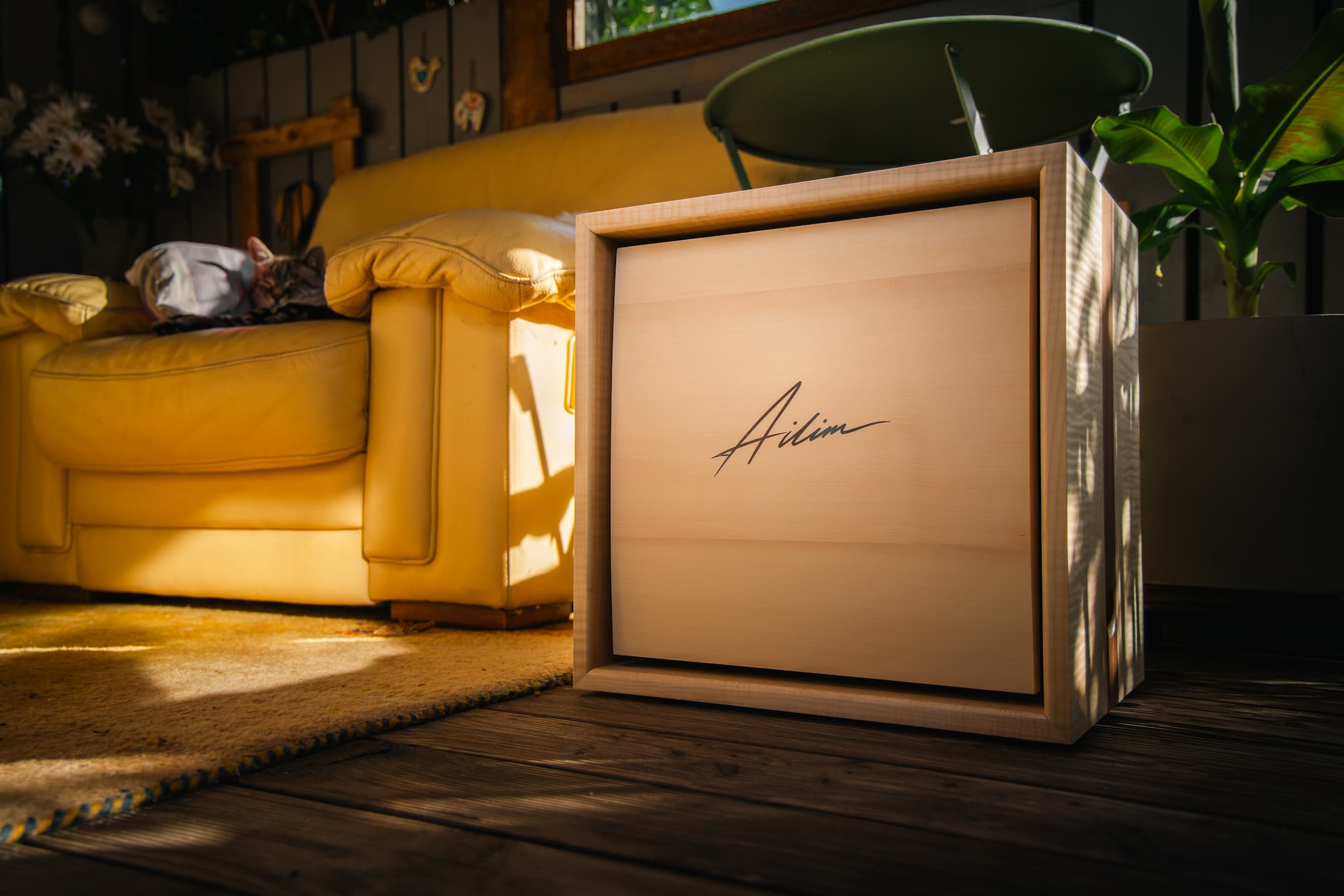
Frequently asked questions
Answers to the questions most often asked about listening, use and caring for your Ailim.
01 Is the Ailim mono or stereo?
The Ailim is a mono device; with two, they naturally become stereo, as two conventional loudspeakers do. However, its design distributes sound far more widely and effectively than a conventional loudspeaker with its directional membrane.
The Ailim’s homogeneous, omnidirectional wave is dense and travels a long distance without losing much energy. The loss is 3 decibels for each doubling of distance because this wave is planar, unlike traditional loudspeakers, which lose 6 decibels. This wave fills the space so completely that a single Ailim is more than enough for comfortable listening. And since there is only one sound source, listening position ultimately matters very little, unlike stereo listening, which requires precise placement of the listener.
In summary, for indoor listening without a fixed listening position, stereo sound is irrelevant: the Ailim excels at producing sound with little loss and in an omnidirectional way, throughout its surroundings. If, however, you want it to create a stereo effect for listening from a fixed position, you will need two.
02 What is the ideal listening-room size to get the most from an Ailim?
You do not need to turn the Ailim up very loud for the sound to fill the entire open space, including adjacent rooms when the doors are open. The sound signal also reaches the different levels of a loft, for example. For ambient listening, 100 to 150 square metres is no problem; and if you turn the volume up a little, you will be so wonderfully stimulated that it will be difficult not to dance!
03 Which style of music is most relevant to listen to on an Ailim?
Every kind of music is reproduced beautifully by the Ailim. Whether classical or rock, it makes little difference: you will feel as though you are attending the concert. The Ailim is highly empathetic with the listener and serves the musical message and the musician’s intent perfectly.
04 What is the best sound source to pair with an Ailim?
The Ailim is versatile, so many different sources can be connected to it. The most common use is a mobile phone connected via Bluetooth. Whatever software you use (Spotify, Apple Music or Qobuz), always choose the best quality available! Over-compressed formats produce a poor, rather “grating” signal. Unfortunately, the Ailim will reveal this acidic quality by highlighting every detail of the signal. The Ailim does not improve or transform the sound. Conversely, feed it a rich and precise signal and the result is all the more engaging: the details, this time virtuous, are perfectly audible.
Of course, for a demanding music lover, the higher the quality of the source, the greater the listening pleasure. In our opinion, vinyl is the finest sound source of all!
Of course, for a demanding music lover, the higher the quality of the source, the greater the listening pleasure. In our opinion, vinyl is the finest sound source of all!
05 Can several inputs be played at the same time, for example an instrument together with a Bluetooth backing track?
Yes, of course. This is even one of the most common uses when the Ailim is used as a small PA system, either to practise an instrument at home or for a small concert in a club, for example. Many different instruments can be connected to the Ailim, from electric bass and ukulele to harp and electric piano, as well as a microphone or a small mixing console!
06 Does the Ailim require any special maintenance?
No, the Ailim requires no maintenance, but it does need a little care. The resonance-spruce membrane is quite delicate and would not withstand an impact, just like the cardboard cone of a traditional loudspeaker. It could split, or at least become marked, and the internal actuators attached to it could come loose.
The Ailim could be damaged if placed in direct sunlight, behind a glass roof or on your terrace when listening outdoors. And beware of rain: like any electrical device, the Ailim is also sensitive to moisture, like any wooden object.
Along the same lines, if you think it would look good to place a houseplant on the Ailim, do not water the Ailim when watering the plant. It will not grow any bigger!
07 Is the Ailim covered by a warranty?
Yes, of course: the warranty covers one year of use from the date of purchase. Although the risk of failure exists as with any electrical device, we have had very few after-sales cases so far; they are most often linked to a domestic accident. It is also fully repairable.
08 Is the Ailim addictive?
To find out, simply savour it for a little while. That is how you will test your strength of character.
09 Are the visible screws on the top and bottom really necessary?
Yes, absolutely. On the other side of the wooden panel are the patented suspension systems for the membrane. A set of silent blocks and fasteners allows the membrane to vibrate freely. All of this is tested and calibrated in the laboratory and must be this way to achieve this level of sound quality. These screws are technical elements, like the wheels on a car, and also allow the membrane to be dismantled if necessary.